From Berlin to Salò
The Sexualization of Politics in Italian Auteur Cinema
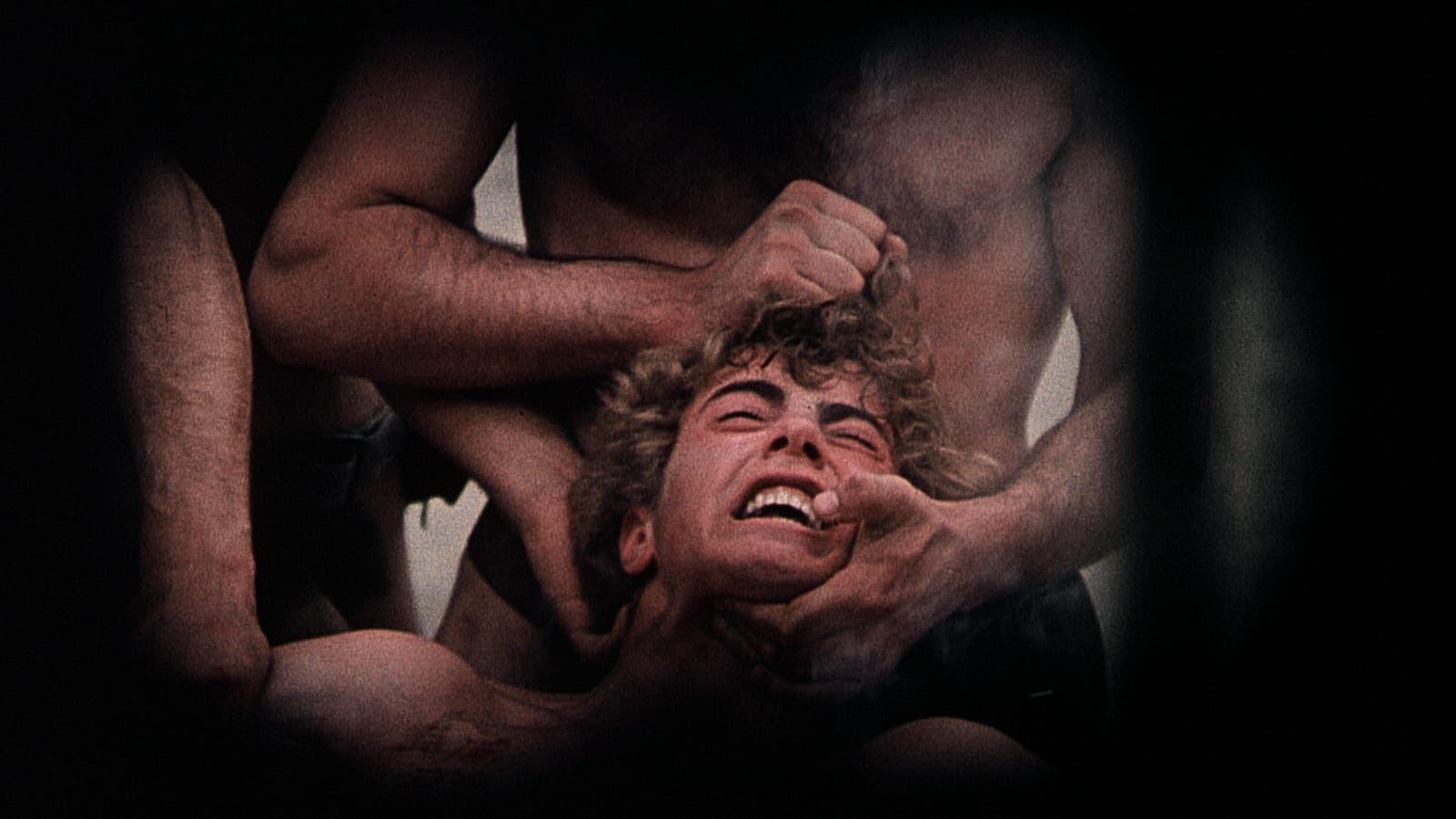
Italian cinema in the 1970s developed a very particular way of dealing with fascism and National Socialism. Political history was relocated to the private realm—to the realm of the body and sexuality. Totalitarian systems not only appeared as political structures but were also translated into psychosexual conflicts. Fascism became linked to desire, submission, violence, and perversion. This association shaped Italian auteur filmmaking, was explicitly expressed in Pier Paolo Pasolini’s Salò, or 120 Days of Sodom (1975), and was eventually repurposed by Sadiconazista, or Nazisploitation, films. The Nazi regime was always interpreted through the lens of the filmmaker’s experience of Italian fascism.
The image of the sexualized fascist had already emerged in Second World War propaganda culture, which presented Nazis as decadent and morally degenerate. After 1945, European cinema adopted these tropes. Roberto Rossellini’s Rome, Open City (1945) characterizes the German occupying forces as cruel, dehumanized figures. Later, war films and Sadiconazista productions linked Nazis with sexual deviance, sadism, and aestheticism.
Luchino Visconti’s The Damned (1969) played a crucial role in this development. Here, the Essenbecks, a family of industrialists, stand for the moral decay of the German elite during the rise of national socialism. The purge of the SA leadership in 1934 is interwoven with a family drama; political power struggles appear as personal and sexual conflicts. Martin Essenbeck (Helmut Berger) embodies the link between fascism, decadence, and sexual transgression.
Bernardo Bertolucci’s The Conformist (1970) proceeds from a psychological premise. Marcello Clerici becomes a loyal follower of the fascist regime out of a desire for personal security and a need to repress inner conflicts. His political assimilation is tightly linked to his private life. Fascism appears less as an external ideology than as an expression of inner vacuity and mental submission.
In The Night Porter (1974), Liliana Cavini explores violence, sexuality, and memory. When they reunite, the former concentration camp prisoner Lucia and the former SS officer Max continue their traumatic relationship. Their liaison straddles the line between dependence and viciousness. Cavani investigates how totalitarian violence shapes the identities of victim and perpetrator as well as their relationship in the aftermath. The film was criticized for potentially aestheticizing historical crimes. The affair, however, is characterized less as a love story than as a reiteration of a destroyed power dynamic.
The pinnacle of this subgenre is Pasolini’s Salò, or the 120 Days of Sodom. Pasolini transposed Marquis de Sade’s novel to the final phase of the fascist Republic of Salò. Those in power secure their rule through humiliation, control, and violence inflicted upon other bodies. Pasolini understands fascism as the model of an “anarchy of power” that can also survive in modern capitalist societies. The violence depicted therefore points beyond fascism toward more general forms of dehumanization. The detached shots make the mechanisms of power visible.
With Tinto Brass’s Salon Kitty (1976), this visual language shifted toward erotic and exploitation cinema. The scenario of a Nazi brothel in Berlin was the departure point for numerous productions about prison camps, camp brothels, and the sexual excesses of the Nazi elite that were far removed from historical facts. Sadiconazista films transformed the connections between National Socialism and sexuality into pornographic fantasy.
This sexualization remains ambivalent. It can reduce complex processes to psychological or sexual deviance, but it also allow viewers to engage with the seductive force of power, aesthetics, and violence. The films remake history as a drama of desire, fear, and destruction. The path “from Berlin to Salò” describes less a historical development than a transformation in cinematic modes of representation—from the image of the decadent fascist perpetrator to an analysis of power, the body, and submission. Fascism here appears both as a political system and as a network of fantasies, fears, and desires.
Marcus Stiglegger is a film scholar, journalist, musician, filmmaker, and, among other things, the author of the seminal book “SadicoNazista: Geschichte, Film und Mythos”.